
The brakes on our 1986 VW camper van felt stiff on the way down Williams Hill, a couple hours south of Monterey, Calif. Then the engine shut off. As Alex coasted and cursed to a stop on the skinny dirt road, I spotted a turkey.
“Turkey!”
Alex grabbed his bow and arrow, leaped out of the van, and chased three turkeys into the woods in his Birkenstock sandals. A few minutes later he emerged with a huge turkey and an even bigger smile. For the first time in our lives we plucked, gutted, and tossed a dead turkey into our solar-powered fridge.
The only problems being, we had no cell reception and our van wouldn’t start.
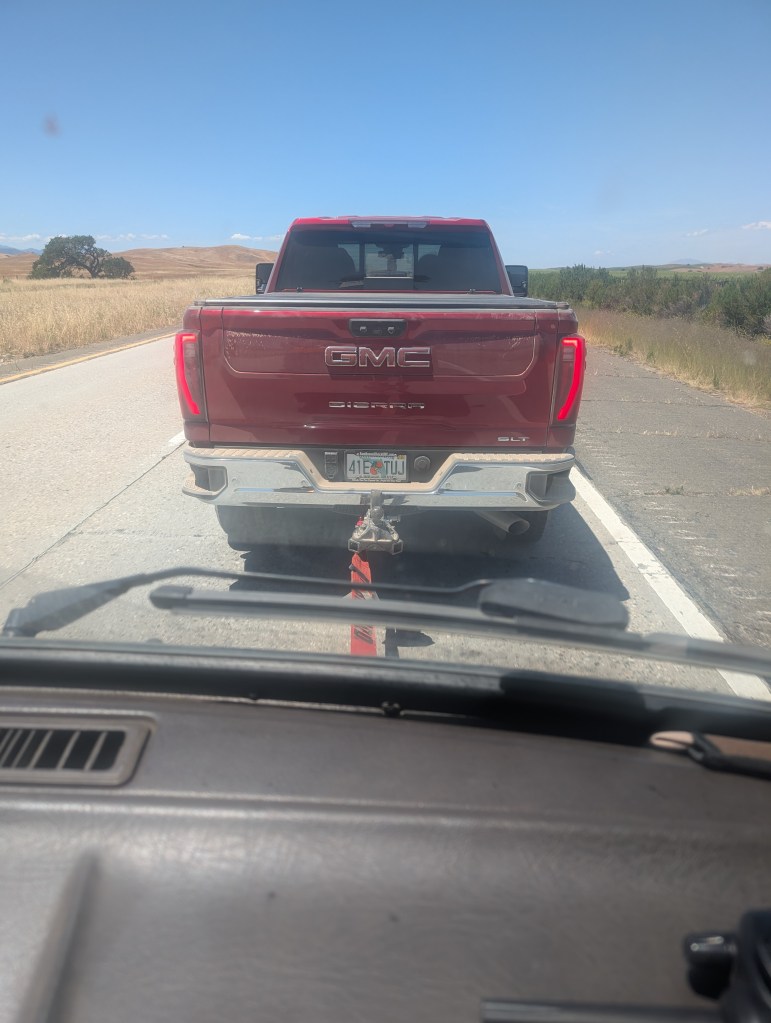
We coasted two miles down the dirt road, getting out to push on intermittent hills. When we reached cell service, we stopped to call AAA when a truck pulled up beside us. A middle-aged couple asked if we needed a hand. We told them a tow was required into town and all we had was a short strap. Steve, 65, freckled and pot-bellied with a happy-go-lucky smile said, “10 feet is 10 feet. We can get you there.”
Dee, 56, a career firewoman with long graying dreadlocks and a thick Boston accent said to me, “We’re just heading into town to get some lick-a (liquor). I don’t want to start to enjoy myself and be trapped on that mountain without booze, you know whatta mean? Anyway, should I just call you Blonde Hippie or you gotta name?”
Over “beah and bah food” (Dee’s diet cheat day) at one of few restaurants in King City, we learned about how Steve and Dee are trailering from Orlando to Alaska with no timeline, no schedule, and no real plans other than to take in nature and a few cocktails. “Retiah early, that’s my life advice” Dee said.
We waited for a new timing belt to arrive at O’Reilly’s auto shop, which was supposed to appear by 6pm. They called in the late afternoon to say the part wouldn’t arrive until the following day.
King City, Calif. has 2 shared rooms available on Airbnb and 8 budget motels. I felt our bed in the van might be more comfortable for one stranded night. There, parked on a city street beside a Carl’s Jr. is where I had to pee at 3 am. Squatting over a jaggedly cut water jug, I rethought this decision.
The next day, realizing it was likely that we required more repairs than just a new belt, Alex walked over to the only respected tow company in town. I sat in Hestia coffee shop and pretended to work, instead, I listened to local ranchers talk about politics and the state of farming. As I ordered a drip coffee, I noticed the framed Blue Zones Project certificate, an effort started by Dan Buettner who identified the “Blue Zones regions” where people live the longest based on diet and way of life. I became obsessed with this idea that food could be healthcare in 2018 after I stumbled upon one of the five regions on a pre-deployment trip to Greece. As the ranchers left, I heard one say to the other, “Do you want some broccoli? I have it in my truck.”
Salinas Valley is dubbed “The Salad Bowl of the World” due to the miles of cauliflower, broccoli, leafy greens and juicy strawberries. How is it that — in a place where friends offer fresh broccoli like chewing gum, where the world depends on the literal fruits of its labor — it required a health food overhaul?
I had questions for our tow truck driver as we rode past hunched farmworkers tending to an endless stretch of crops. His answer: H-2A Visas.
The H-2A program is working, but it might not be working in the way you think. Thousands of illegal immigrants who work the fields of Salinas Valley have moved back to Mexico. It’s too expensive to pay what used to be a $5,000, now $12,000, cartel fee to gain entry into the country, find housing, a car, pay for food and save money to send home in one of the most expensive regions of California. With the threat of mass deportations, they have given up on their hope of achieving the American Dream. But, farm owners can’t find Americans to replace those 50,000 workers. The majority of our nation’s produce, grown in the Salad Bowl and other regions of California, will simply be left to rot without them.
Agricultural employers have looked for legal ways to bring workers through H-2A visas — requiring them to provide housing, food, and transportation. When employers started buying up local housing complexes that provided shelter for low income King City residents, it pushed residents out onto the streets or elsewhere, some of whom labored in the fields. As a result, the companies decided to build new housing for migrant workers. And not the kind that crams people into a small space, rather, town homes and multi-family living spaces.
American farmworkers who are struggling to afford Monterey county rent and have been working the fields for decades, making additional funds by renting rooms or selling cars to immigrants, are frustrated to watch migrant workers enjoy better living conditions while avoiding the cost of gas ($5.12 per gallon — Alex found a place before Monterey county to avoid these prices), price of a dozen eggs ($8-$9 — in Berkeley we paid $6 per dozen), and an average single family home rent of $5,000 a month.
Our tow truck driver seemed sad about the whole thing, expressing that the city is a ghost of what it used to be.
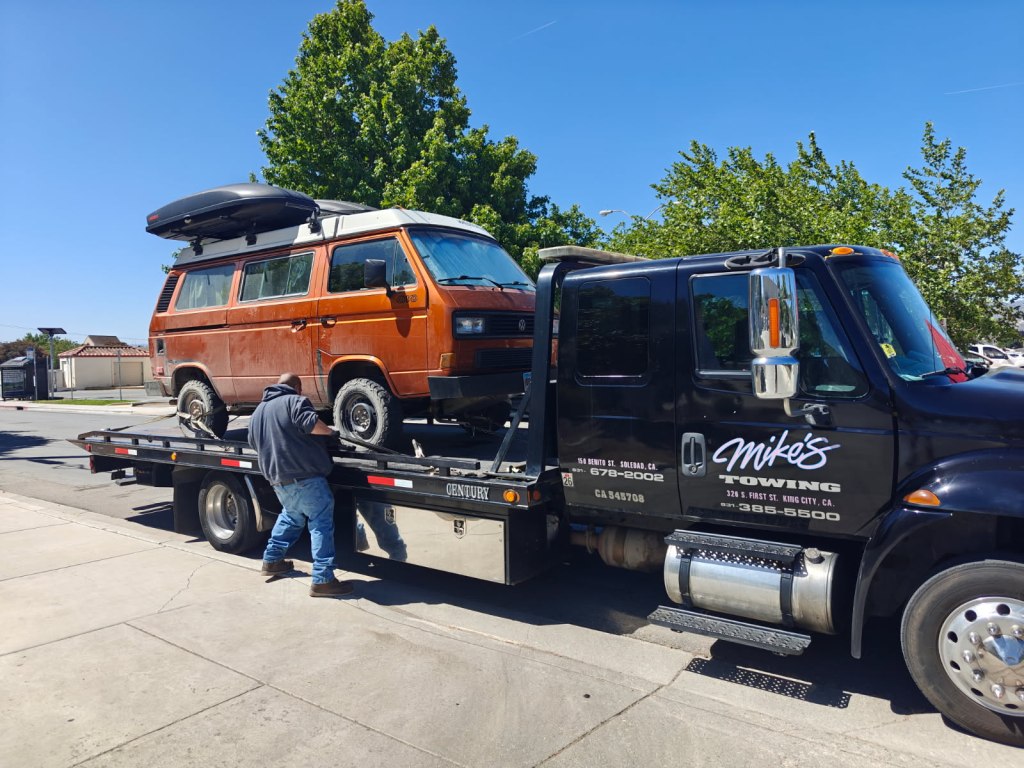
We dumped the van at German Motorwerks, got a rental, and hightailed it to Moneterey’s wharf. Beside fishermen working to catch a day’s pay, locals trying to hold onto their youth slurped lunchtime martinis and oysters at The Sandbar. The first bottle of wine on the list was called Williams Hill (the name of our campground), we took it as a sign and got the whole bottle, then feasted on clam chowder, Caesar salad topped with crab meat, and fish & chips — forgetting for a moment that the van would cost thousands, we still needed to drive home through rush hour traffic, and we had no idea if the turkey would fit in our sailboat oven.
It didn’t.
The following day we returned the rental car to Monterey and booked a cottage with an oven and laundry unit for the weekend in Lexington Hills. To our surprise, the neighboring home was built by John Steinbeck and his wife Carol in 1939. This was where Steinbeck finished writing The Grapes of Wrath, fittingly about migrant workers moving from Oklahoma to Salinas Valley, California during the Dust Bowl searching for their American Dream.
At a mountainside winery, I closed my eyes as I sipped the “crisp,” Chris assured me, 2022 sauvignon blanc and thought, “Ah, yes. Surely I smell tropical aromas of mango and papaya with notes of pineapple. Surely I am tasting the strong melon finish.” Then I thought, “This must be where I belong” — until I remembered pissing into a Crystal Geyser jug with the lid cut off in a busted VW van on a street in King City.

 Erin Edwards